
Back to the list
Congress: ECR26
Poster Number: C-10572
Type: Poster: EPOS Radiographer (scientific)
Authorblock: Y. Ohashi, K. Harada, T. Tanaka, S. Hayasaka, K. Ishibashi, R. Kasahara, N. Yama; Sapporo/JP
Disclosures:
Yoshiya Ohashi: Nothing to disclose
Kohei Harada: Nothing to disclose
Takeo Tanaka: Nothing to disclose
Shun Hayasaka: Nothing to disclose
Kizuku Ishibashi: Nothing to disclose
Ryo Kasahara: Nothing to disclose
Naoya Yama: Nothing to disclose
Keywords: Colon, Vascular, Veins / Vena cava, CT, CT-Angiography, CT-Colonography, Colonography CT, Contrast agent-intravenous, Physics, Biological effects, Cancer, Inflammation
Purpose Contrast-enhanced CT colonography (CTC) is commonly used for preoperative evaluation of colorectal cancer, enabling assessment of tumor morphology together with mesenteric vascular anatomy.

High-quality visualization of the mesenteric veins, particularly the inferior mesenteric vein (IMV) and superior mesenteric vein (SMV), is clinically valuable for precise preoperative vascular mapping and for assessing extramural venous invasion (EMVI) in colon cancer, an important prognostic indicator of tumor spread [1–3]. Accurate evaluation of these factors contributes to optimal surgical planning and reduces the risk of unexpected vascular injury [4,5].
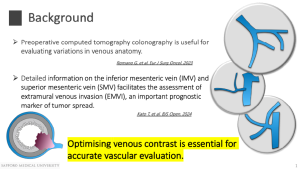
Fig 1: Preoperative CT colonography enables detailed evaluation of mesenteric venous anatomy. Accurate visualization of the IMV and SMV is essential for assessing extramural venous invasion (EMVI), a key prognostic marker in colorectal cancer.

Carbon dioxide (CO₂) insufflation is routinely used in contrast-enhanced CT colonography to ensure sufficient colonic distension. Recent studies suggest that, beyond luminal expansion, CO₂ may exert vasodilatory and microcirculatory effects [6,7]. This study investigates the effect of CO₂ insufflation during CT colonography on the peak arrival time of mesenteric venous enhancement, with a particular focus on the IMV and SMV.
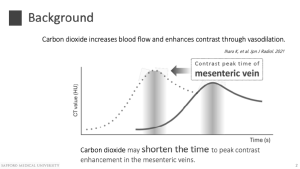
Fig 2: Carbon dioxide insufflation induces vasodilation and increases blood flow, which may shorten the time to peak contrast enhancement in the mesenteric veins.

GALLERY